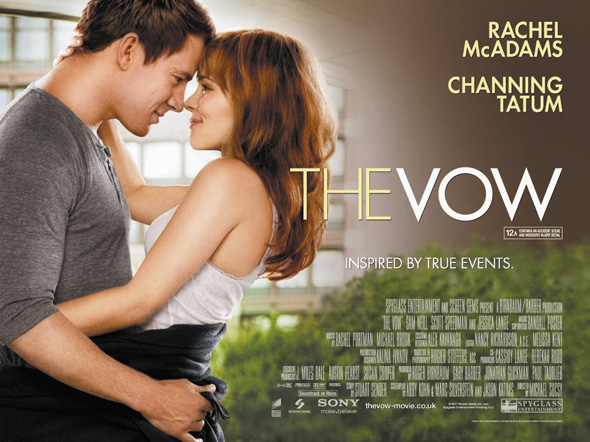
Premiering on Valentine’s Day weekend in 2012 and starring teen heartthrob Channing Tatum, The Vow advertised itself as a simple romantic comedy and, ultimately, brought in almost $200 million. Not just based on a true story, the film is based on a book of the same name. In 2000, Krickitt and Kris Carpenter, in association with a professional author, penned a novel about their romance and, specifically, their romance following Krickitt’s brain injury. However, the film removes or reimagines key elements of their saga, in hopes of making it less factual, but more box office friendly.
First, it should be noted that I have not read the book. My comments are solely based on viewing the movie and reading related articles and reviews. What I can say, is that the movie downplays the immediate and ongoing problems of a brain injury. The incident itself is shown to be traumatic enough to literally launch Paige (Rachel McAdams), as Krickitt is renamed, through the windshield glass. Paige is taken to the hospital, the doctors inspect her comatose body, etc. After she awakens from this state, though, Paige doesn’t seem to have memory problems as severe as they would be, in reality. Additionally, she does not seem to have major speech impediments nor physical hinderances. Her time in rehabilitation has been eliminated from the plot.
Paige seems, more or less, to be the same women she was prior to her trauma. However, a brain injury changes who you are and how you think and perceive things, as does any traumatic event. In the film, Leo, representing Kim and played by Channing Tatum, is forced to “play parent” to his new wife. One wonders why he is willing to do this for a woman he has known for less than a year and been married to for mere months. Unfortunately, the real divorce rate, not directly after, but generally following a spouse’s brain injury is higher than average. (The exact number is under debate.) In the past decade, studies have shown that the probability of marriage ending in divorce is 40-50% for all Americans, with rates increasing as education is lowered.
The book reveals that the reason the couple stayed together was because of their mutually strong religious beliefs. Apparently, what first attracted Kim to Krickitt, and vice versa, was her Christian beliefs. In Christianity, marriage is a lifetime commitment and divorce is a sin. Religion is rarely shown as a strong positive factor in Hollywood films and was removed from this film.
In response to such criticisms, the film’s director, Michael Sucsy, has said, “This is a movie, not a documentary.” True, but for many teenagers, to whom this movie was targeted, this was their first emotional interaction with a brain injury survivor. Therefore, I would have hoped that Paige’s recovery would have been a bit more realistic.
Note: In 2018, after 25 years of marriage, Kim and Krickitt split up. What prompted this split was Kim’s admission of infidelity. After the commitment he showed after Krickitt’s brain injury, this is a surprise.
 TBI on the Screen